
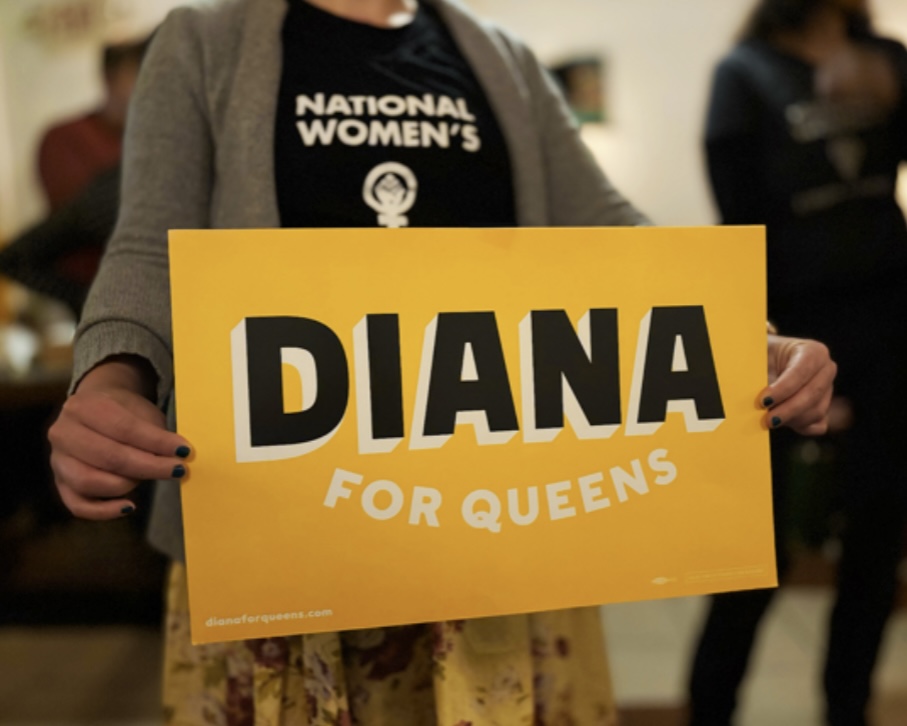
National Women’s Liberation Candidate Interview with Diana Moreno
Diana Moreno Interview for NWL Endorsement
This interview has been edited for length and clarity.
→ Read National Women’s Liberation’s endorsement of Diana Moreno
January 20, 2026
What made this feel like the moment to run for office?
Becoming a mother for the first time in 2024 really changed everything for me. Running for the state assembly—traveling to Albany for half the year—was not in my five-year plan. And honestly, neither was having a socialist mayor.
Zohran is a big part of why I’m here. I’ve organized with Queens DSA since 2019 and worked with him before he was even an assembly member. When he ran in 2020, what stood out was how clearly and boldly he talked about what the state should actually be responsible for and how to fund the basic services people need. He ran at a moment of real political crisis and offered a real alternative.
When Zohran launched his mayoral campaign, I was pregnant with my first child, and I was ready to go all in for my comrade. I was in his launch video with my three-month-old, saying, “I want to raise my kid in New York,” because universal childcare was part of his platform from the beginning.
I didn’t expect him to win. I really thought we’d get maybe 15 percent and get our ideas out there. Instead, he ran a campaign grounded in small-d democracy—thousands of volunteers knocking on millions of doors—and he won.
On primary night, after his historic upset over a political dynasty, people started asking whether I would consider running for his assembly seat. I initially said no. As a working mother, the burden felt enormous.
But the political crisis didn’t let up—Trump’s second presidency, the continued genocide in Gaza—and at the same time, the hope Zohran represented. I realized this is not a time to be cautious. If trusted comrades are telling me this is my role, then I’ll play it.
I don’t see this as a career path. I see it as my role in a socialist movement.
I don’t want to be represented by a career politician—I want to be represented by a movement person. I’ll be an organizer first, and that’s how I’ll govern.
In the state assembly, what actually determines whether things move forward or stall?
Like Congress, the New York State Assembly is designed to centralize power in leadership and limit the power of individual members—especially those who challenge the status quo. It’s really a structure that challenges people who challenge power.
That’s why it matters that I’m running as an organized socialist, not as an individual with strong ideals but no connections. Going in with a cohort of comrades who are already in Albany changes what’s possible.
Relationships shape how things move, and so who you’ve been working with over time makes a difference. That’s also why endorsements matter. Not just because they look good on paper, but because they signal real relationships and real power.
I plan to maintain respectful relationships with leadership, but I also want to work closely across the legislature with people who are already focused on healthcare and labor issues. And beyond elected officials, I see it as my responsibility to stay closely connected to unions and community organizations like NWL.
If I’m going in as an organizer first, then my job is to bring those voices into the legislative process. My power comes from the people in the district, not corporate money. That’s the model Zohran showed, and it’s the one I plan to follow.
What had you been doing in New York before deciding to run?
I worked for New Immigrant Community Empowerment (NICE) in Queens for four years, doing grassroots immigrant worker organizing with some of the most vulnerable workers in New York City—supporting undocumented workers, connecting people to legal services, fighting wage theft, and protesting bad bosses. A lot of that work was with women: care workers, cleaners, and immigrant women, including women in construction.
It was deeply meaningful—and deeply exhausting—work. When I knew I wanted to become a parent, I needed something more stable. In 2023, I transitioned to New York State Nurses Association (NYSNA), doing communications work: training nurses to speak to the press and helping them advocate for themselves. It’s an overwhelmingly women-led profession, many women of color and immigrant women.
That job made it possible for me to have my child and take parental leave. It felt like a continuation of the same values, but with the stability I needed at that point in my life. And honestly, that’s what I was doing until some folks convinced me to do this crazy thing.
What are women being asked to handle on their own right now that government should be responsible for?
Women are being asked to handle everything. All the consequences from these federal cuts come down to us. When funding for Medicare and Medicaid is cut, who’s going to be doing that care work for deeply sick people? It’s going to be women.
We’ve also seen this with federal job cuts. Government layoffs have disproportionately affected women, and especially Black women. Those were some of the few good government jobs women and women of color were able to access, and when those jobs are gone, the impact falls hardest on women.
This is a deeply misogynistic economic system, reinforced by a federal government aligned with corporate power. You probably have the same image in your head that I do—bro-ligarchs standing behind Trump at his second-term inauguration. All of the tax funding for care work is being stolen from the American people and redirected into the pockets of billionaires.
Women are being asked to handle everything.
And right now, we’re seeing greedy bosses feel emboldened. New York City’s nurses are being left out in the cold on strike. They won incredible, historic contracts in 2023, and I really think what we’re seeing now is punishment—bosses pushing back against the power those workers built, encouraged by a pro-billionaire, anti-worker White House.
That’s why it’s so important to have leadership willing to champion pro-women policies—to say universal childcare is a responsibility of government, and that housing and healthcare are rights. To me, this is a clarifying moment. It’s a moment of political crisis, but it’s also a moment where people are ready to be bold. We can show what an alternative looks like, and we cannot let that opportunity pass.
What material changes should women experience because of state policy?
Universal childcare would be transformative. We’re already seeing signals around funding 2-Care and making 3-Care universal. I’m paying over $32,000 a year for childcare right now, and I’ll be real—that’s unsustainable. That would be a real, material difference for working families: money back in people’s pockets, more stability, and the ability to plan a future.
Housing and immigrant protections are just as critical. Right now, undocumented immigrant families are afraid to leave their homes or send their kids to school. Women in those families are often the ones staying home, losing income, and caring for children they’re too scared to let leave the house.
If we pass the policies I want to pass—and if we become a community that looks out for each other and keeps each other safe from ICE—that produces a material gain people will feel in their daily lives. It means being able to work, to send kids to school, and to live without constant fear. New York has to be a place that actively pushes back against isolation and terror, not one that reinforces it.
How do you think about success if you’re governing as an organizer?
I won’t measure success by how many bills I pass or what titles I accumulate. For me, success is material change in my district, relationships built, dollars brought home, and legislation shaped by the people most affected.
Am I bringing my community along in this journey? Are immigrant women part of the legislative process? Am I funding community organizations that are building real power?
This role is in service of a movement—and that’s how I intend to govern.
How did your organizing experiences inform how you think about politics now?
NWL shaped how I think politically. When I was a college student in Gainesville, I was involved in left movements—farm worker rights, my graduate student union, the Alachua County labor coalition.
I got involved with NWL through the campaign to get the morning-after pill over the counter. That was a real, clear goal that would have a material impact on women, and it taught me a lot about how NWL organizes.
I learned that you have to go for what you really want, and to ask who benefits and who pays from a decision. That’s how you start thinking critically about who holds power and who is exploited by abuse of power. It was about having real, material goals that would actually impact women’s lives and push back against misogynistic systems.
NWL has been the most impactful for me in the long term, in how I think about politics and how I think about organizing. The grounding I got there really bloomed when I came to New York, because of the organizing and political development they helped me achieve. Honestly, some of the best organizers I’ve ever organized with have come out of NWL—people who really challenged me to think critically and to challenge power in a way that was grounded in class.
I carry that with me everywhere I go, including in DSA, where I’ve been most active in New York City.
Being endorsed by NWL means a lot to me. This organization played a real role in my political development, and to have that support now is an honor.